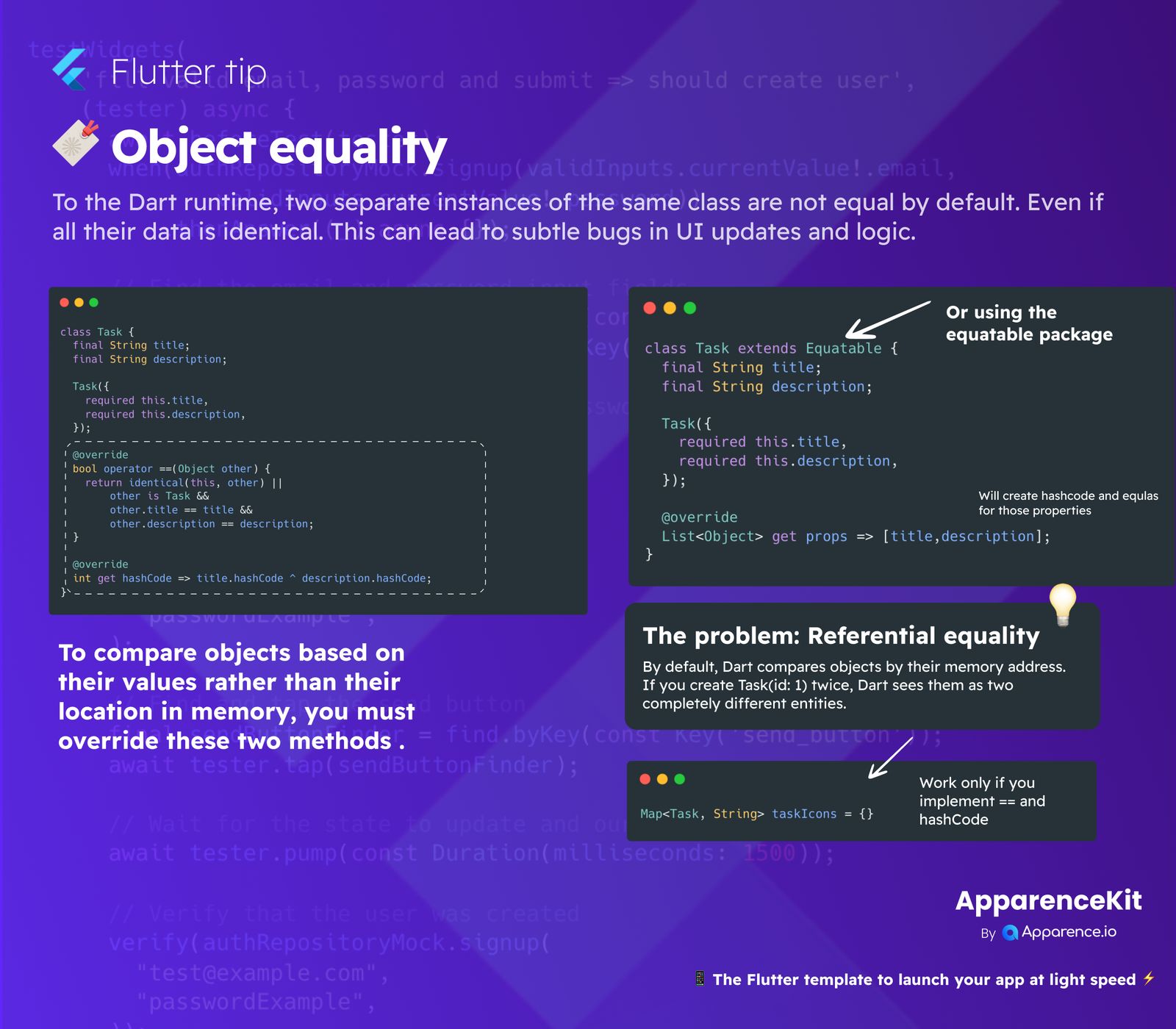
To the Dart runtime, two separate instances of the same class are not equal by default, even if all their data is identical. This behavior can lead to subtle bugs in your app's user interface updates and overall logic.
The Problem: Referential Equality
By default, Dart compares objects based on their memory address. Think of it this way: if you create two 'Task' objects that look identical (e.g., both have 'title: Buy groceries' and 'description: Milk and eggs'), Dart still sees them as two completely different things because they exist at different spots in your computer's memory. This is called referential equality.
Achieving Value Equality
Sometimes, you want objects to be considered equal if their values are the same, regardless of where they are stored in memory. This is known as value equality. To make this happen, you have two main approaches in Dart:
1. Overriding the == Operator and hashCode Method
To compare objects based on their values, you need to tell Dart how to do it. You do this by overriding the == operator and the hashCode getter within your class. The == operator defines when two objects are considered equal. The hashCode is a special number that helps Dart quickly tell if two objects might be equal, which is crucial for collections like Sets and Maps.
How it works:
==Operator: You implement logic to check if all relevant properties of two objects are the same.hashCodeGetter: You combine the hash codes of the relevant properties to create a unique hash for your object. If two objects are equal, their hash codes must be the same.
2. Using the equatable Package
For a simpler and less error-prone way to implement value equality, you can use the popular equatable package. This package helps you avoid writing the boilerplate code for == and hashCode manually.
How it works:
- You extend your class with
Equatable. - You override the
propsgetter and provide a list of all the properties that should be considered when checking for equality. Theequatablepackage then handles the==andhashCodegeneration for you based on these properties.
Why This Matters
Implementing value equality is vital for many reasons, especially in Flutter development. It ensures that your UI updates correctly when an object's data changes, even if the object itself is a new instance. It also helps in scenarios where you're comparing lists, filtering data, or using objects as keys in maps, ensuring your application logic behaves as expected.